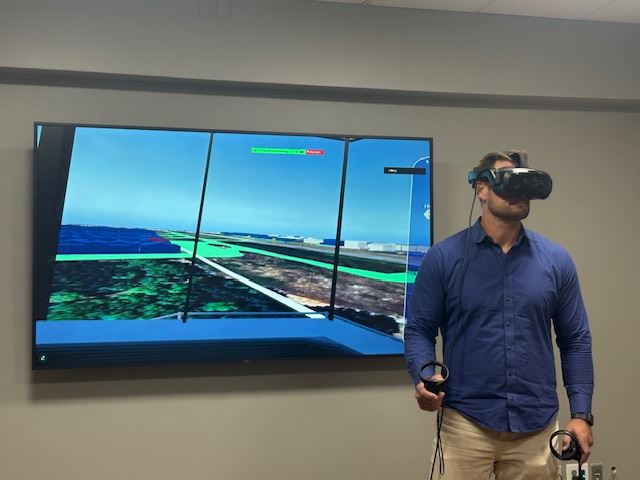
Charlotte-Monroe Executive Airport looked a little futuristic this week. Inside a conference room, City leaders and federal aviation experts peered through advanced 3D modeling software, watching the sunrise and fog roll in from imaginary vantage points high above the runway. The exercise wasn’t science fiction, it was the Federal Aviation Administration's (FAA) siting study to determine the perfect location for the airport’s first Air Traffic Control Tower.
Over two days, September 3 and 4, officials from the FAA worked side by side with Monroe leaders to narrow down where the tower should stand and how tall it needs to be. The study is a critical step toward building a tower that will not only improve safety for pilots and passengers but also help position Charlotte-Monroe Executive as a key hub for business and general aviation in the region.
On September 3 and 4, FAA officials brought advanced 3D modeling technology to Monroe to help determine where the tower should be placed and how tall it should stand. The process gave participants the opportunity to see simulated views from potential tower sites under different conditions, including dawn, dusk, fog, and clear skies. The goal was to select a site that will serve pilots safely today while supporting the airport’s long-term growth.
Charlotte-Monroe Executive Airport was accepted into the FAA’s Contract Tower Program in 2023, guaranteeing federal support for tower operations once construction is complete. The City has until November 2028 to build the tower, a project expected to elevate the airport’s role as a regional hub for business and general aviation.
With the study wrapped up, the FAA will now compile findings and recommend the final site and specifications. That report will guide Monroe’s next steps in design, funding, and construction.
For City leaders and aviation partners, this week’s effort was a glimpse of Monroe’s aviation future.
“Having the FAA conduct the siting study for our new Air Traffic Control Tower is a critical step to move this project along,” said City Manager Mark Watson. “We are grateful to the General Assembly for providing six million dollars to make this possible. This investment will strengthen safety, support future growth, and ensure Monroe’s airport is well positioned for years to come.”
“I was honored to participate in the process employed by the FAA to ascertain the optimal location for our airport tower,” said Mayor Robert Burns. “My primary objective is to ensure that the construction and placement of the tower do not exceed the allocated funds from the state while simultaneously maximizing its utilization for future airport development plans. We are diligently working to expedite this process so that we can proceed with the next significant project that will bring immense benefits to our entire city. I extend my sincere gratitude to our staff and the FAA for their invaluable time and guidance in facilitating this endeavor.”
“The City of Monroe is proud to maintain one of the busiest general aviation airports in the state of North Carolina. We have been working tirelessly to have the final component to this equation, which is a contracted tower. As always, our number one goal is safety, and this addition to our airport campus is essential. It will serve our many base customers into the future,” said Council Member James Kerr.
“The City’s goal has been to select the site that serves both current and long-term economic development needs for the future,” said Assistant City Manager Lisa Hollowell.